
Steve Jobs would’ve loved this! A restaurant that once famously turned him away taps AI to staff the phones: an Expedite Q&A
Kristen Hawley
Originally published on her Substack
Almost 15 years ago, Apple co-founder and CEO Steve Jobs was turned away at the door1 of San Francisco pizza and pasta hotspot Flour + Water. It was a moment perfectly centered in the Venn diagram of my interests: a legendary techie stymied by the real-life frustration of waiting in a line and subsequently failing to snag a popular table — in my neighborhood, no less!
It’s easier to get a seat now, and I suspect a tech boost or a different door policy would have changed the outcome for the visionary founder today. (We’ll sadly never know.) But as a post-Jobs Apple readies the release of some transformative AI of its own, so has Flour + Water embraced this rapidly evolving technology, tapping a young voice AI startup to answer its phones.
In a recently unearthed clip from 1983, Jobs is heard describing futuristic technology that sounds a lot like today’s artificial intelligence: a machine that would capture someone’s “underlying spirit, or underlying set of principles, or any underlying way of looking at the world.”
Jobs was talking about Aristotle here, not a restaurant host. But the spirit, principles, and even worldview of a seasoned and hospitable host is a valuable asset. Even so, Amanda Flores, the director of operations at San Francisco’s Flour + Water Hospitality Group, was more excited about outsourcing the restaurant’s phone lines to a bot than I expected.
I’m not sure why this surprised me. Maybe I have my own outdated notions about in-person hospitality. Maybe it’s that I rarely call restaurants myself. Maybe I’m skeptical that people are ready to start picking up their phones after spending so many years texting instead.
I’m clearly wrong 2.
“It’s been a really nice change,” Flores told me in a recent interview.
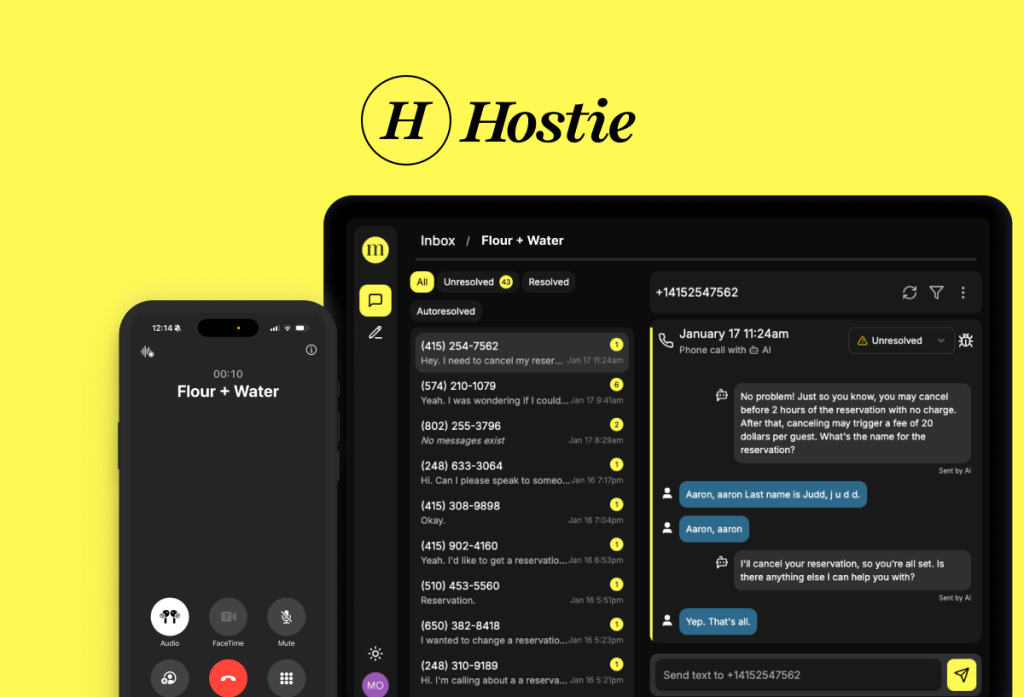
Flour + Water works with a local startup, Maitre D AI, built by co-founders Randall Hom, an Instacart product designer-turned-restaurateur, and Brendan Wood, previously a founding engineer at an AI startup.
Maitre D is young. It’s taken a small round of friends and family funding; Hom is still hands-on with restaurant clients as they work to build and improve the product. That makes this particular example feel like an honest and, daresay, a relatable process in what is still very early days of helpful voice AI. (When Hom implemented the tech at his restaurant, he described it as “almost a euphoric experience” to hear the AI respond to calls.)
I talked to Flour + Water’s Flores about implementing the new technology, which, in a matter of weeks, helped the restaurant learn more about its diners. Chiefly, they call… a lot.
Our conversation has been lightly edited for length and clarity.
Expedite: Why did you decide to implement AI technology for phone calls? Was it an easy decision?
Amanda Flores, Flour + Water Hospitality: “We try to stay ahead of the game. Before Covid, we had a formal office and admin teams that answered the phone. It was a really nice touch. But their workday ended at five or six o’clock, and guests had trouble reaching us during service. It was impossible to bring back the position of someone sitting in a room, answering a phone after Covid. We want to pay people fairly, and labor in restaurants is already such a high percentage of our operating costs.
“I really value restaurants that still have that human touch. That’s obviously the ideal scenario. In fact, I called [nearby, notable restaurant] Foreign Cinema the other day and someone answered.”
A person! I agree that’s ideal, but have heard it’s increasingly unsustainable.
“We had to find a way to meet in the middle. During Covid we had a set voice message on our phone line, and we worked to make sure it included as much information as possible.”
I remember that message. It was very long.
“It was basically, here’s the business hours, here’s how to get a hold of our service team. Here’s how to get a hold of our events team. We take care of all these dietary restrictions… but that’s not what people are looking for. It answers our most common questions, but it’s missing that hospitality piece. We encouraged people to email us, but it just isn’t prompt enough and doesn’t have that special touch.
“We were hesitant to switch to AI. We pushed it off for a while despite all of the companies that wanted to work with us, because I wanted to make sure it was developed enough. I didn’t want our guests to suffer more from speaking to a robot. We didn’t want to leave them with more questions than answers.”
That’s a good threshold. Do you feel like you’ve reached it?
“We didn’t realize how lucky we are to have such a high call volume, because we weren’t answering phones. We learned were getting up to 1,000 calls per week3. Everyone, including Maitre D, was surprised at the actual volume of requests we were getting. And we immediately started tweaking the service to make sure people were getting answers. Just four weeks in, we had over 1,300 phone calls resolved through AI.”
And what if it isn’t resolved?
“The system offers to text the caller a link for more information, and we get notified about it. The AI will ask if the caller wants to be put in touch with someone who can resolve the issue, and we say that we’ll make sure to reach out in 24 hours. That way, we’re not setting an unrealistic expectation that at 7pm on a Friday, the host has the capacity to text you in that moment. We’re down to about five unresolved calls per day that go to the restaurant’s host stand.”
So it sounds like diners are into this. They’re accepting of the robot answering the phone.
“There’s always the negative side. Generationally speaking, some people are less eager for AI, they want a person. But generally, we’re finding that people walking in the door already have answers to some of the questions they’d walk in with prior. That means fewer people walk in frustrated and the host gets to spend more time with people that are stoked to be here with their questions already answered4. People are getting quicker responses from AI and that makes them more open to the technology.”
Does the voice sound human? I’ve spoken to other restaurants using this tech and have heard mixed feelings about whether or not the voice should sound like an easily identifiable robot.
“It’s a good mix of human and robotic voice. The first version was a little curt5, and we’re working on her getting a little sweeter. I think she should be named after Flour+Water. I’ve thought about this, “flour” in Spanish is harina, and that could be a really cute name for her.”
[Ed note: A few weeks after our initial interview, I called back and Harina answered the phone. She also explained herself: “I work best when spoken to like a person. How can I help you?6”]
“Now we’re working on reducing stall time. She’ll say, ‘Let me think about that,’ and respond a few seconds later.”
So, so far so good?
“We’ve definitely curated how to work an AI system for a really busy restaurant. And our managers can look through the resolved list and look for trends or keywords. I’m sure we’ll need to add more holiday questions into the mix soon.”
I love Flour + Water, I’ve been to the restaurant, I’ve also tried and failed to get in. Obviously you have to say no a lot. I imagine it’s nice to offload the ‘no’s to the bot?
“It seems like it’s easier to take the ‘no’ from a bot than from a voice message. But at our restaurant group, we’ll always encourage our community to be able to eat here first. You can’t add your name to the waitlist over the phone. We want people walking around the Mission to be able to sign up with us7. Or just walk in!
“That’s what we care about. It’s always been a challenge of ours, people saying they can’t get in. That’s why I like the verbiage of walking in to sit at the bar…we only have 11 reservable tables. It really is a small restaurant.”

This link only kind-of works; you’ll need to Google to find the actual photos.
Which is a little silly considering I’ve covered the rise of phone-answering AI in hospitality since at least 2023 with a post titled ‘Gen Z will call the restaurant’. It’s creeping into third-party delivery, too!
That’s *a lot* of calls for a restaurant of Flour + Water’s size.
I feel like this is an important and underestimated point. When the bots do the heavy lifting, the smiles become more genuine on both sides of the host stand.
Hom called it “sassy,” which I kind of love. (But I can see how this sounds a little inhospitable to a caller trying to check on wait times or similar.)
This move is intentional, Hom says. People are still learning how to interact with the newest generation of voices on the phone, and too many were barking one-word commands like “reservations” the same way they’d speak to an automated customer service rep at an airline.
Hom says about half of the calls his bots answer overall have to do with reservations and walk-ins. At Flour + Water, Harina explicitly encourages walk-ins, and Hom says the restaurant experienced a lift in the number of walk-ins it’s welcomed since introducing the AI.
 Hostie Blog